
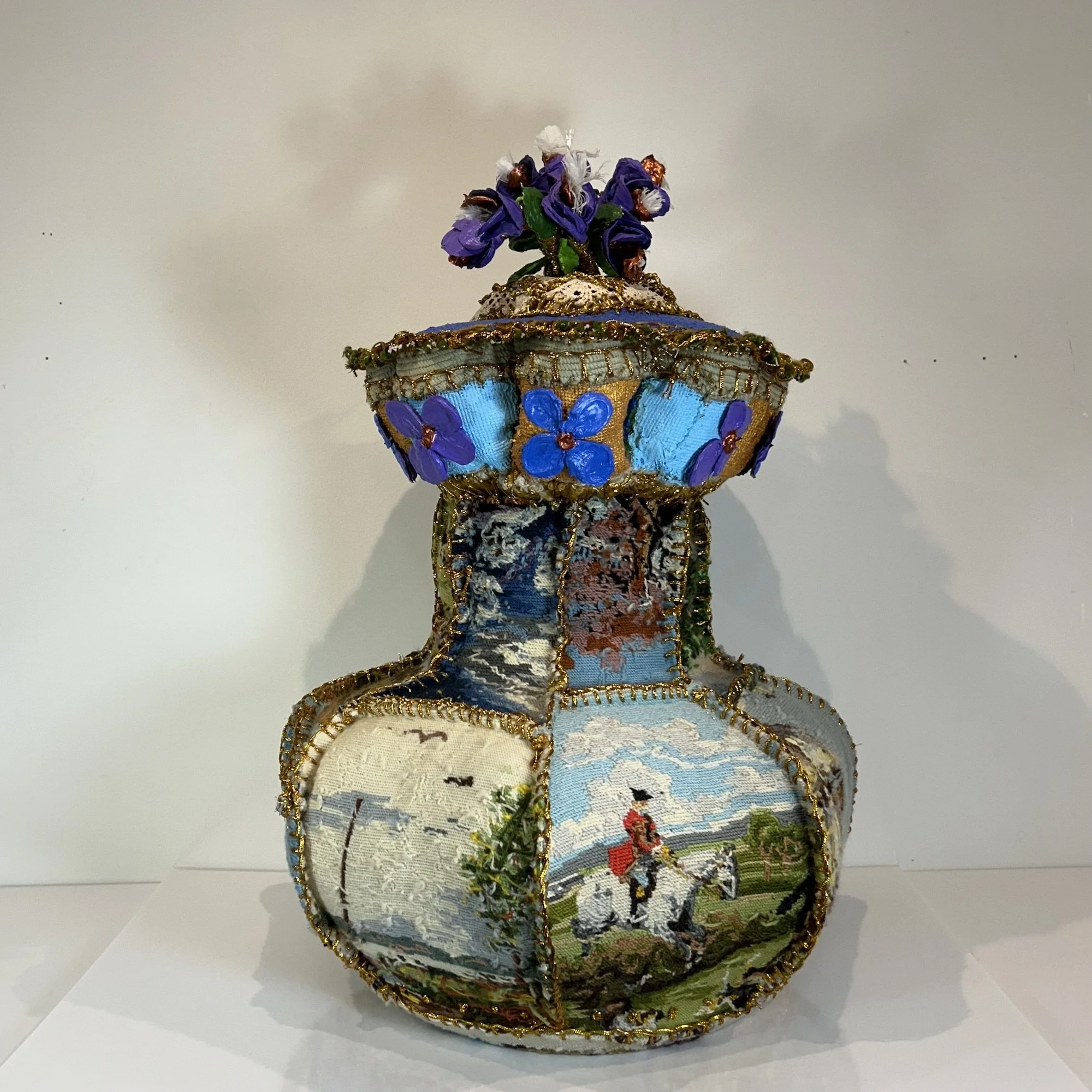
The sculpture above called “Forget Me Not” is being shown in the exhibit at Agora Gallery! It is approx. 22 inches wide by about 30 inches High. Made by homemakers from embroidery kits of famous landscape paintings. Here I express myself in a sculptural form of a vase and flowers which many homemakers would spend hours on in a sense of accomplishment and beauty. I have constructed the vase by hand stitching the entire artwork and painted the top rim and created flowers from paint. There is also a crocheted form at the top to balance the flowers in the vase. It is still a work to bring together the fine art world and craft.
An essay by Kim Wilkie
It has come to my attention a couple of times in the last few weeks that the popularity of textile based work being shown everywhere from the Venice Biennale to major retrospectives of textile artists in prominent Museums world wide may just be a fad or a passing recognition of the times we are in. I was at an inauguration of the International Contemporary Textile and Fibre Art Symposium called Changing Landscapes in Hamilton, Ontario at The Cotton Factory, when I heard textile weaver/designer speak about her dislike of all this attention for textiles being displayed as fine art. At first I was shocked and realized I needed to think on this topic a bit more. Then a post on Instagram where again the textile work in galleries was being called out to point out and that there is a distinction to be made here. This particular Instagram page had so many comments about liking the fact that finally, textile was being seen as fine art but nothing explaining exactly why the attention of textile art being included as fine art was disliked in the actual post.
For me, I am happy to have the attention because I have used thread, string and yarn in many of my artworks through out my fine arts degree, but also I continue to use textiles and fibre in my paintings mixing the two and enjoying it. Both these areas was my familial and educational experience and background. I began using textiles because of the courses in school. Mainly in my primary grades, seven and eight, in a mandatory Home Economics course where I was taught how to cook and was also taught weaving, embroidery work, sewing. In high school only the sewing of clothes was taught and now it is an elective course for interest sake only. The reason I continue to use textiles in my artwork was to bring textiles into the fine art world. It was always considered a utilitarian craft. Well, my thoughts are that it is technology that has changed the textile base craft to a use in the fine arts. It was transitioning while I was making my art in my fine arts courses when I was in university.
I recognize the issue, too how textile and fine art have come together but has the educational system changed their minds on what textile work is all about? I read a book just after I graduated from University which propelled me forward within the textile realm. It was called “Women’s Work The First 20,000 Years” by Elizabeth Wayland Barber, First Edition 1994. It was explicit in telling the painful truth of the past of textile work and it was an eye opener. Women were the workers of any textile base and I believe this history should be taught beginning as a history course in high school and it would be prudent to say it should be taught in a university platform, which is probably the point of any disagreement towards textiles and fine art. I know that the craft/design history (although historical pottery was a point taken in the Medieval Art History course) has not been taught at Western along with other utilitarian arts. They are still considered craft and designated to Sheridan Collage with a Degree in Craft and Design and the history of the craft is being taught along side the training. The issue for me comes where these crafts are not taught in the fine art course in university but displayed today in fine art exhibits.
I began using textiles with paint in university to elevate the textile base to fine arts because of the discrepancy of not being accepted into exhibitions as a craft as well as a secondary placement of women’s artwork in and around the gallery and museum systems. This is a rivalry in both areas at the same time. Conceptual art work brought this in for me, but it is the roots of my familial life that brought me to both fine art and craft. It is who I am. Last year I bought another book again called ‘Women’s Work, From feminine arts to feminist art” by Ferren Gipson it displays all of the women artist’s who have used textile as their fine art practice. Here it proves that artist have used textile in the arts for quite some time but usually not in its traditional form. I have seen a few exhibitions lately, and I do have to admit the use of the textile materials are mostly shown in traditional format. (large hanging cloth and at times formed) The book mentions the recognizable names, of Sheila Hicks, Louise Bourgeois, Judy Chicago and Judith Scott to name a few. They have used textile to send a message in the fine arts. They have provided the feminist message in this book but also a message of again correcting the history of art. It needs to be done within the school system to corroborate the influx of textile based artwork (because I see it as that) within the fine art exhibits world wide. How can the textile artwork have any legs in the fine arts, even though they have been pushing at it for a while, if the history or ‘the how to’ is not incorporated within the fine art educational system. Another book I have depicts women sewing, spinning and weaving from the 1500’s in famous fine art paintings, in a book called “In Praise of The Needle Woman, Embroiderer’s, Knitters, Lacemakers and Weavers in Art” by Gail Carolyn Sirna, 2006. This book of paintings does show women in their domestic roles historically (a good record) and in itself the divide between the fine arts and craft. My artwork lies on the joining of fine art and craft but also the fact that I am a woman in the fine arts. I believe things have changed as far as the fine arts is concerned towards textiles. Time will tell. Women are now exhibiting more, is this part of the a temporary fad in the changing milieu of our times or a change from conceptualism to a living experience of accepted humanism?